Designed AI Market Insights to help Indonesian casual investors make more informed decisions.
Concept mobile app • 2026
Problem
It all started with a question in mind, how do we help Indonesian beginner & casual investors make more informed decisions before buying any investment assets while most of them rarely read any financial statements, prospectuses and only skim some news. This led me to explore how investment asset information could be made easier to understand and investigate.
Competitive analysis
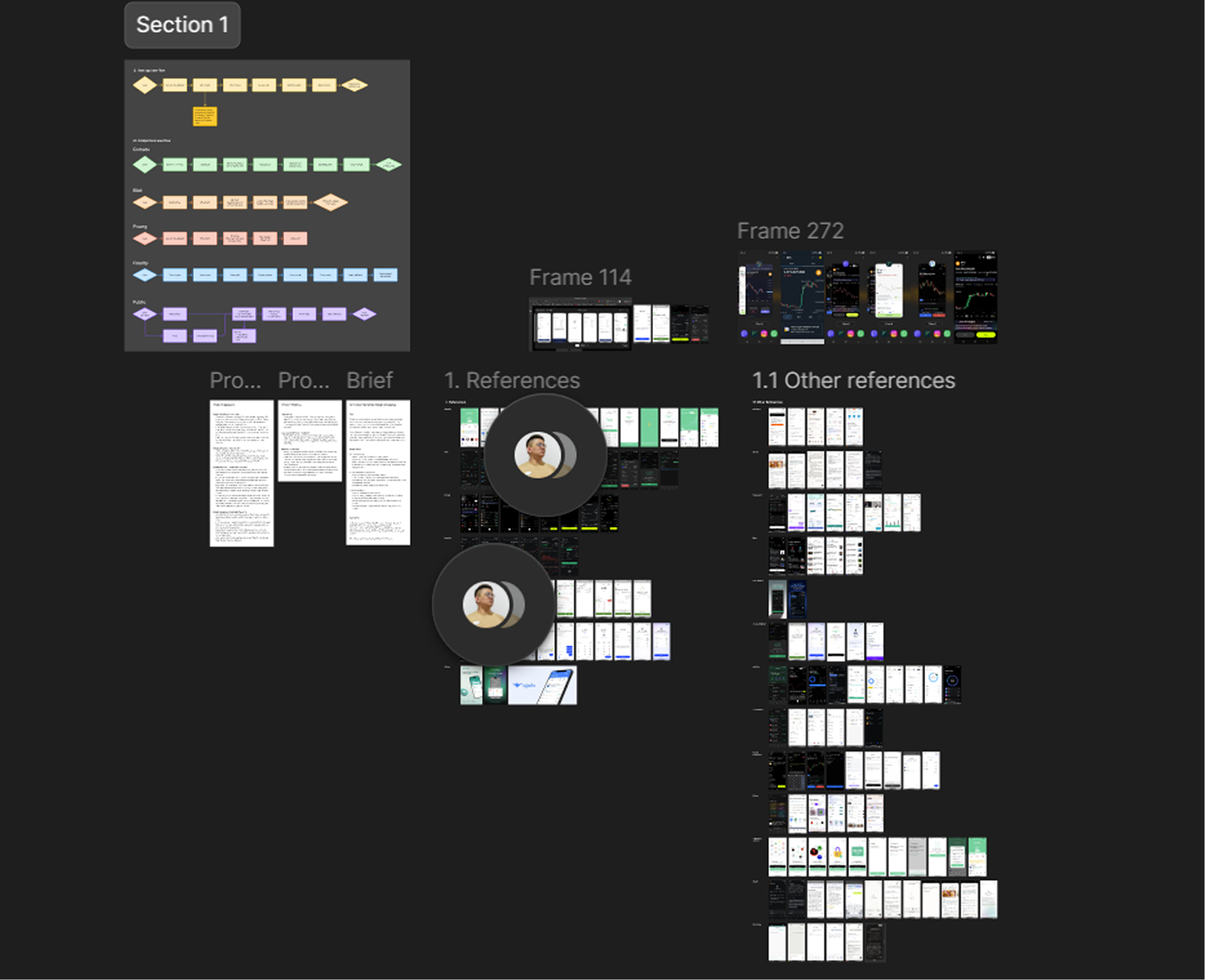
Before designing it, I benchmarked popular investment apps like Gotrade, Pluang & Bibit via Chamjo & downloaded app on my phone while also searching for foreign investment apps like Public from Mobbin to understand the full flow to build the user flows.
To build the user flows I use Claude Code via Figma MCP to draft it on FigJam file, sourced from Mobbin screenshots that I previously gathered to simplify the language.
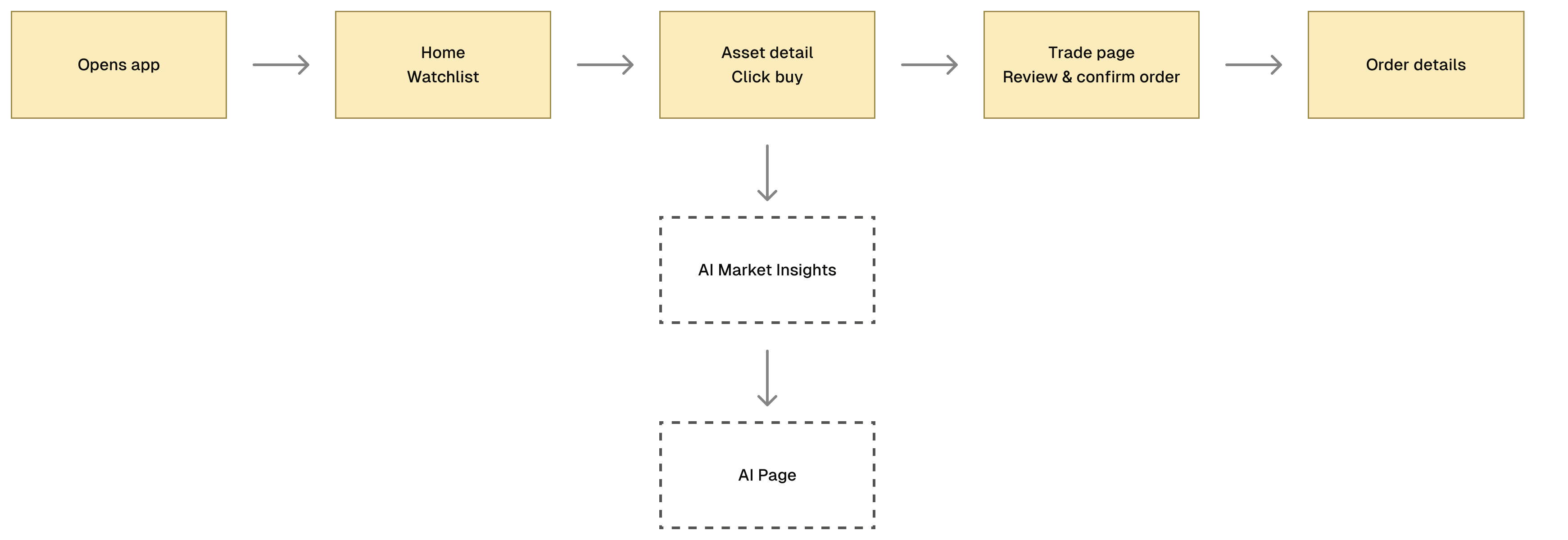
- Opens app
- Home
Watchlist - Asset detail
Click buy - AI Market Insights
- Trade page
Review & confirm order - AI Page
- Order details
By understanding the flow, I have a hypothesis of using AI summaries in the asset detail page because Public & Pluang implemented it. Public’s Alpha covers assets such as ETFs, bonds, treasuries and crypto while Pluang’s Aura AI covers US stocks, crypto and gold in crypto & ETF forms such as PAXG, XAUT & GLD.
But none of them covers gold in digital form backed by physical gold and Indonesian stocks because Public.com is US based app but Pluang serves Indonesian market. So, I take that as an opportunity to integrate AI summaries in Indonesian stock & physically backed digital gold.
I also noticed that Pluang’s Aura AI only gives user a set of predefined questions, while these questions are a good start, it may not address other questions a user thinks about an asset.
I saw an opportunity to explore a more flexible experience where users can ask their own questions to shape their own point of view of an asset rather than relying on a limited set of predefined questions.
Design decisions
With the analysis phase done and I had a clearer direction, I decided to design end-to-end Indonesian stock buying flow from home until order details page to practice designing full flow mobile app.
Before iterating on AI Market Insights, I reviewed OJK’s regulations (Financial Services Authority) on the code of conduct for what the AI can & can’t do to understand the constraints relevant to an AI assisted investment experience.
POJK No. 5/POJK.04/2019 states it is prohibited to promising a specific result to be achieved if the client follows the advice provided and providing advice to clients regarding the purchase, sale, or exchange of Securities without a rational basis;
Chapter 3, Article 2, points e and f translated from Bahasa Indonesia into English.
With this information, I explored an approach to make the AI as an information aggregator to help users understand an investment asset based on relevant market news, financial statements and prospectuses. I iterated on how information is presented and making it looks unified with the product.
Some decisions that come out from these explorations:
1. Building dedicated AI page
I made AI Market Insights accessible by clicking the AI Market Insights card or via navigation bar. With the prompt bar & questions suggestions the users can ask their own questions about an asset rather than limiting the capability into a predefined question only.
2. Adding timestamp & cited trusted sources
Transparency is crucial especially in finance, because users need to know from which sources I read this AI summary and are these sources trustworthy? Public has the timestamp, while Pluang doesn’t have it.
Therefore, below the title I added timestamp & based on how many sources this summary is generated and also added a small shield icon on the right side of the sources to indicate that these sources are trustworthy. Because sources count doesn’t guarantee that sources are trustworthy.
3. Adding edge cases
I can’t confirm whether Public & Pluang have any edge cases for their AI feature, but as an information aggregator there are 2 edge cases that I found.
First one is if there are insufficient data for newly published asset and second when the market closes on weekends & public holidays, the card shows the latest price & timestamp to help users understand that the information may not reflect current trading activity.
Reflection & next steps
In the end this is a concept project of how AI can be integrated into a high-risk financial product like an investment app. Since I’m new in finance product design, with this case study I learned that other than design research to understand user flow, I should do a little regulation research if I’m going to suggest a summary features and make sure the sources viewed as trustworthy source.
I found this approach has a business constraint, which is how frequent the AI summary is updated. Because generating and refreshing AI summaries at scale will cost the company significantly.
If this were made in a real product, I would like to test on several things such as:
- Do users actually click on the AI button or a summary on asset detail page is already sufficient?
- Can the AI provide accurate information for other asset class like crypto or gold because 2 of them used different set of data?
- How many users use related questions vs typing them in the prompt bar? Because if the related questions are rarely clicked, the questions might not be relevant to the response above.